Posts

Showing posts with the label pollination

Insect Declines and Case for Long-term Insect Monitoring in India
Image
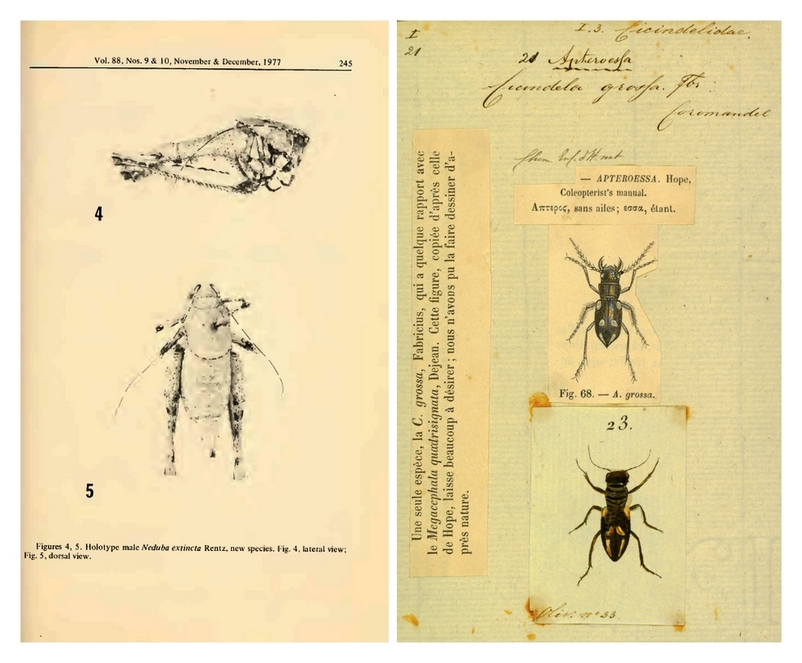
Separated by 15,000 km, tied to the same fate.  Left : Antioch dunes shieldback katydid  Neduba extincta , declared extinct by the time of describing the species from the Antioch sand dunes of USA (Rentz, 1977; see  archive.org ; under CC BY-NC 3.0);  Right : Enigmatic tiger beetle  Apteroessa grossa  (Iconographia Zoologica - Special Collections University of Amsterdam; see  Wikimedia Commons ), not seen alive along the coastal and wetland areas of southern India; both gone because of severe land-use changes from ill-informed infrastructure developments. ‘Nature is under siege’ begins a collective of publications (Wagner et al., 2021) addressing the inquiries on the ‘validity of claims of rapid insect decline’. Within the last two decades, several studies established declines in insect abundances based on long-term monitoring data: In Great Britain, aerial biomass of insects studied between 1973 and 2002 showed significant decline in one of the four s...
The Ants and Elephants of Ecosystem Restoration

Image
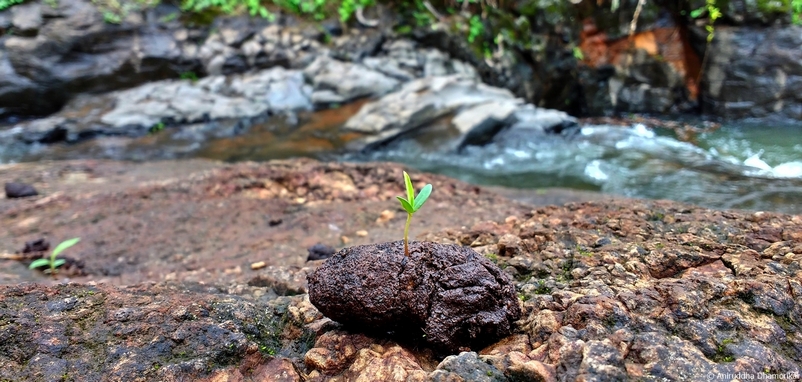
From inside the dung of a macaque a seed sprouts. It will be carried in the swell of this wild Kalu River till it takes hold along the riverbank and bury its roots deep into the earth, making its mark in rewilding the Earth. A zoochorous seed’s journey Towards the beginning of winter when wild grass is heavy with seed, clumps of discarded seedcoats can be seen at terminals of tiny whitish lines drawn across the forest floor. These small lines belong to a specific ant – the Harvester Ant. In India, ants in the genus Monomorium , Pheidole , and Meranoplus discard parts of seedcoats in heaps – called ant middens – around burrows that lead to their underground nests. Midden of a Harvester Ant ( Monomorium  sp.) in a meadow in northern Western Ghats. Grass seeds are dispersed by wind, eaten up by passerines, and collected by mice. Ants are the lesser-known hoarders – more than handfuls of seedcoats of assorted grasses can be collected from the middens in the peak of the harvest seaso...

The Merrywinkle Grove

1. A foxbee trots in a grove, flower-to-flower, her tail flailing side-to-side as her wings buzz to-and-fro Ere darkness she returns to her burrow, a small furrow, amidst Merrywinkle Grove, of lush greens and violets against white snow. A warm hearth in her heart beats rhythmically to the thrum of the Earth, waking with a soft glow. She buzzes ere break of dawn to visit the lawn unkempt and unowned in the little farm brazen and forlorn. In cups of merrywinkle in thickets of pinthorn, spikelets of ashybrush and bristlecorn, vines of contorted forms, Step-by-step, on nimble feet, she takes a sip, her wings beat, oh, what fate, in has crept, of cold sprinkled hate. 2. A fire-tailed rat offers petals to greet, and caches merrywinkle seeds to eat, ten feet ‘neath the peat. When the winds blow cold, with cotton his burrow he’d mould, and sleep on his bed of leaves in autumn breeze. He wakes early at daybreak, with the first summer shake, his blazing t...

A flower-loving gutter fly

Image
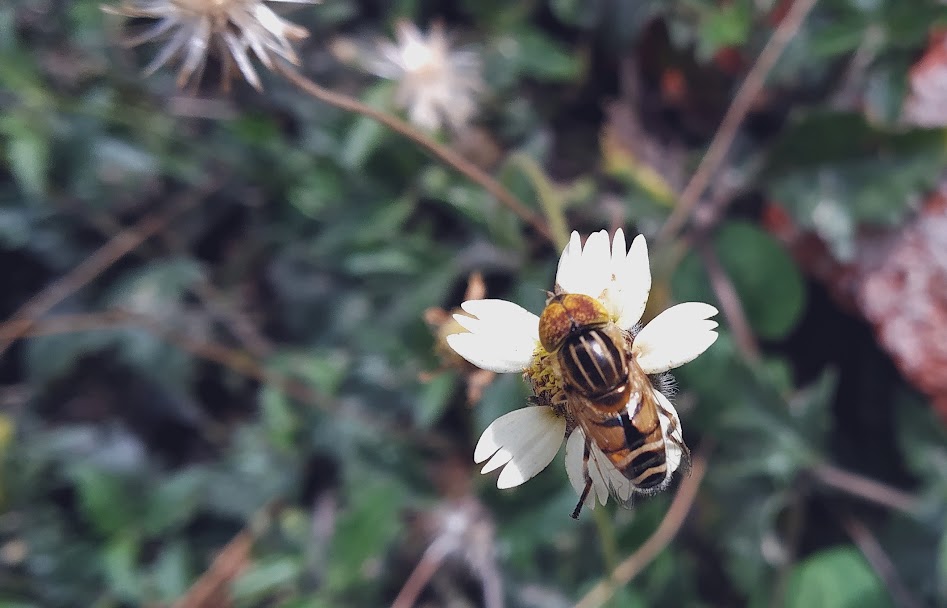
Not five feet from an Indian Almond ( Terminalia catappa ) tree abuzz with insects is an open gutter. The sewer runs along the corners of houses, its soiled waters shadowed by an avenue of jamun ( Syzygium cumini ), kadam ( Neolamarckia cadamba ), and Indian almond trees. The almond and jamun trees are blossoming, their pale, snowy-flowers arranged as a whorl around slender, soft-green branchlets stick out from under a flush of broad dark-green leaves, liberating a strong sweetish aroma into the heavy summer air. This is in the middle of the city. Every time I enter or leave my office, I hear the trees abuzz with insects. Sharp, short buzz of insects hopping from one flower to another, lapping up the extremely sweet nectar contained in bowl-like flowers. The gutter is riddled with tubiflex worms. When I was a kid, my father would purchase live tubifex worms from aquarium stores for his fishes, and occasionally weird worms would come with it. The one I have a distinct memory of was...