Posts

Showing posts with the label kutch

Three Seasons

Image
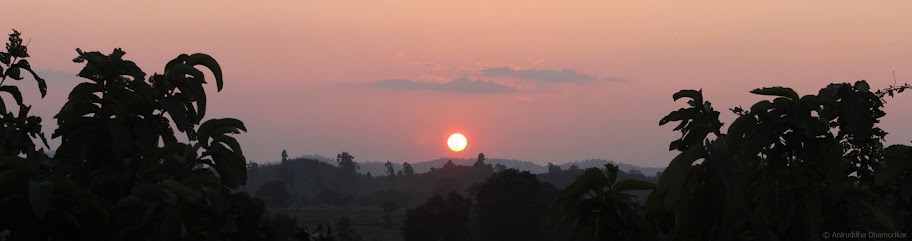
That yellow tint to leaves is forlorn. It is sad to see them shrivel, shiver, and fall off. I’m standing in front of a line of bamboo islands I’ve been watching for three winters. The cold January breeze helps them shuffle and shed their green coat – it is time , it whispers as it blows the leaves away onto the hardened ground. They say winters of Kanha are the shortest. But I found that we age faster in winter. Kanha’s winters are louder because of the rustling leaves, and the sound picks pace as the seasons age. The longest is summer that proceeds winters with such subtlety that you don’t realise it advance like the winter – winter grips you through your bones, summers are hard to comprehend. No one — man or woman — feels an angel when the hot weather is approaching , stated Rudyard Kipling in the classic Plain Tales from the Hills. And it remains, and lingers, and makes one endure, or yearn, for a better season. Then it happens, the sky bursts under pressure, rain tear...
Kutch: the invisible wilderness

Image
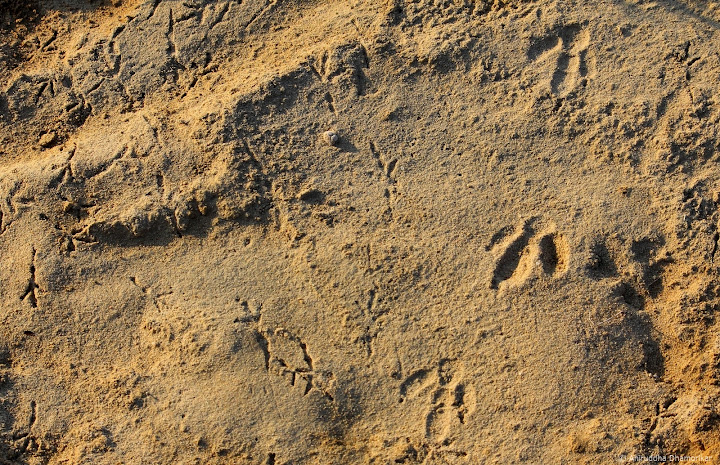
The salt-sprinkled chocolate browns of the estuarine mudflats are criss-crossed by the prints of carbon-black tyres. The wind is crisp, and the recurring whoop-whoop-whoop of the enormous ghostly wind turbines is ubiquitous, occasionally punctuated by sounds of trucks that trod on the pathless mudflats to reach the nearest salt port. On this truck-trodden path, we look for signs of a particular bird that blends well with the grey-brown landscape, the MacQueen’s Bustard, a rare winter migrant. It is nowhere to be found, but along sparse grasses, pale green in colour, are tracks of various birds imprinted on a layer of fine, seemingly frozen crust of sand. One of which belongs to this bird. The smaller tracks belong to, we think, Desert Warblers; those small, hypersensitive brown birds seen probing the grass strands for tiny morsels during early winters. The largest of all, the three-toed prints, belong to the Common Crane, we acknowledge without a doubt. We saw them graze in a small ...

Sands and Wetlands

Image
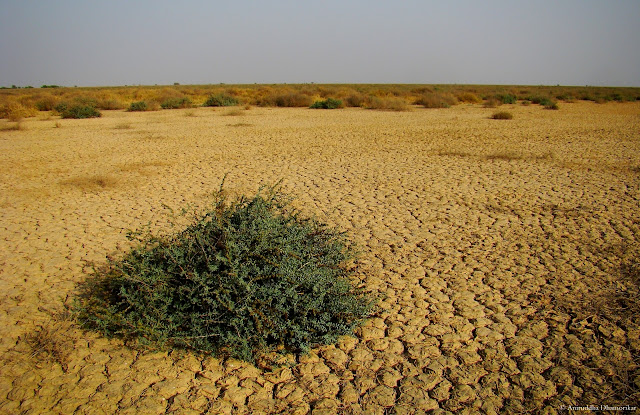
A girl with hazel eyes disappeared in a cloud of glimmering sand. She wore a maroon dress. Wrapping her head was a long red scarf, her large green eyes – a symbol of this region – gleaming through her half covered face. We came to a halt at a village by the sandy road, our guide addressing the folks for directions in Kutchi. I was in an unfamiliar terrain in one of the corners of India, where the language is strangely beautiful to hear – a mix of sindhi, gujarati and rajasthani. An amalgamation that is only unique to the Kutch region of Gujarat. The semi-arid regions of Kutch For as far as my eyes could see, the earth stretched for miles – its flat surface laid out for our feet to explore. A number of shrubs prospered in this semi-arid landscape, thriving on the scarce water received six months ago. This unique region, a part of the famed Banni Grasslands, forms a crucial habitat for many animals, resident as well as migratory. On our way through the desert we glimpsed a large mi...