Posts

Showing posts with the label long point waterfowl

Decoys, Shotguns and Conservation
Image
A male Bluebill I wandered far into the woods, into the lakes and over the snow, and waited patiently for an approaching deer, or a turkey, or, if I am on the lake, a duck, in anticipation of shooting one. But I found myself sitting on a bus on the way to the railway station. I was wondering what exactly I was going to do in the following 24 hours. It took me 6 hours to reach London, where it would have taken about 2. Nonetheless, I was too excited about the following day to be bothered by hours of waiting for buses and trains. I met a friend and we headed Turkey Point. We started much before sunrise on the next day, as I piled layers of clothes to be able to withstand freezing cold and blistering winds blowing off Lake Erie. We joined two more friends, and then headed towards Long Point. Our trucks were full of decoys, anchors, guns and shells and two joyous canines. We loaded the stuff onto the boat and cruised towards the bay. It was foggy, damp and cold, and as our boat picked...

In Conversation with Sandhill Cranes

Image
Grus canadensis , Sandhill Cranes on the lake “I’m not sure if this is related to the [study of] environment …” said a colleague with a shrug. I was talking about the project I assisted for in the past two months. According to him, studying Sandhill Crane study is not a part of environmental studies, or I may simply say wildlife study is not related to environmental studies. So what is environmental studies – is it sitting in the labs measuring the amount of Carbon dioxide in the air, or the amount of heavy metals in the water, or environmental policies and laws that we study in our class? I never had to answer this question. Because I never separated these aspects of environmental studies from nature. A talk with the colleague revealed a great wisdom of academic knowledge, but he failed to impress me with his words I repeated above. I think, and I hope I am wrong, that he forgot what environmental studies is for – it is not for the sake of the pollutant we discover in air or water,...

Long Point and the Bay

Image
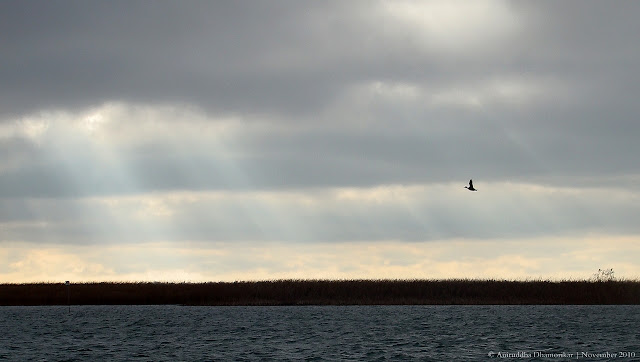
Looking over the Inner Bay, Long Point There are places on Earth where over thousand birds stage during migration and where birders and other experts flock to cherish this grand congregation, one of such places is Long Point. Situated in Lake Erie, Long Point Sand spit was created over the last 4,000 years due to the high shoreline availability of glacial till, strong winds, variations in climate, hydrological cycle and seiches. These forces continue to shape Long Point, the largest sandy peninsula (or Sand spit) on the Great Lakes. Long Point’s Inner and Outer Bays and their associated marshes are one of the most biologically important areas – not only for resident birds but for migratory waterfowls of North America as well. This is because Long Point falls under the Atlantic flyway of migrating birds, providing them stopovers for feeding. One can easily guess why thousands of birds decide to stop at Long Point Bay – it is diverse in its floral and faunal diversity – from various...