Posts

Showing posts with the label heritage

On the Book of Central India – Part II: The Doubt

Image
With my Northeastern buddy the Horay-bellied Himalayan Squirrel relishing Arunachali oranges. On July 7, 2013, a week after moving to Kanha, I journaled my observation on nature and human-nature interactions in Central India. My first ever memory is of an effervescent girl gently smacking a cow about to feed on someone’s backyard garden. With her brother in one arm, dressed in old school uniform, the barefooted girl led a line of cattle into the forest for grazing. This memory is as fresh as if it occurred only yesterday. She compelled me to look at myself, insecure and closed to the world – her world – shoed, full-sleeved, afraid of ants and mosquitoes, whatnot. That year, malaria, a millennia-old scourge of Central India, especially the hill regions, was particularly bad. Amidst this, from my cocoon, I romanticized the forest village life to my unadjusted unaccustomed infant eyes, and I imprinted on her, whom I ultimately followed, like cattle in a line, to see without rose-tinted gl...

On the Book of Central India – Part I: The Drive

Image
  Returning to the roots, the book sits along one of the many rivers it journeys with, Banjar On February 1, 2025, Our Roots Run Wild, a book of the history of the highlands of Central India, was published by The Alcove Publishers of New Delhi. Released at a small non-event at the New Delhi World Book Fair where I felt too embarrassed to talk or sign the book, it marked the day the book became available as paperback and e-book, primarily on Amazon India. This is a short three-part series on the writing journey of this book that I let consume me. In 2016, I started writing a longform essay hoping to publish it as a booklet of my experiences working in Madhya Pradesh, particularly in the region of Balaghat, Mandla, and Seoni districts. Working on the issues deemed important for wildlife conservation – particularly of large wild mammals – had put me in touch with the grassroots quite intimately. I worked not only for but also with the local communities, the Baiga folk, in particular...

Hampi: Written in Stone

Image
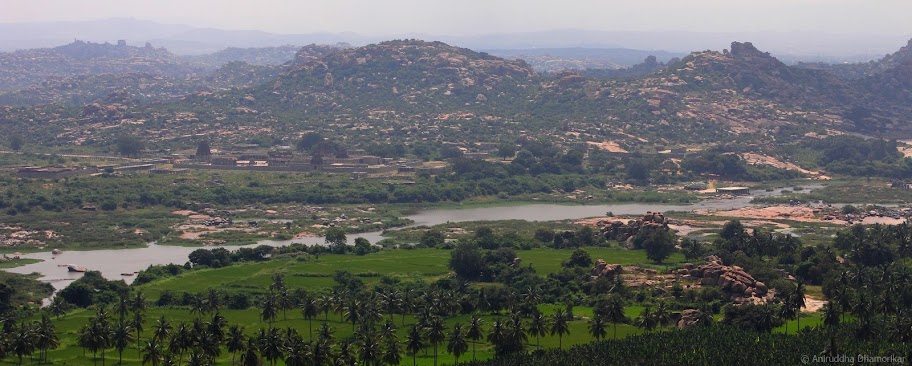
The rotund rock formations can take the form of the most bizarre shapes when viewed through a layer of hot air rising from the sandy gravel on the banks of Tungabhadra. We stood at the northern bank of the river, on an island called Virupapuragadde, awaiting the ferry that would take us to the ruins of the capital of the Vijayanagara Kingdom, Hampi. It was hot, and Laxmi, the sacred elephant of the Virupaksha temple, was being bathed by her mahout as a horde of tourists photographed her from all sides. Under a stony pillared mandapa built five hundred years ago on the bank of the river sat women who offered their hair in grief, as an honour to the departed. On the eastern side of the bank children jumped into the river from boulders resembling elephant humps, and played in the quieter regions of the rive as River Terns glided overhead, scouring the waters for fish. The Tungabhadra River and the landscape of Hampi A day earlier, we arrived on the northern shore of Tungabhadr...

In God's Garden

Image
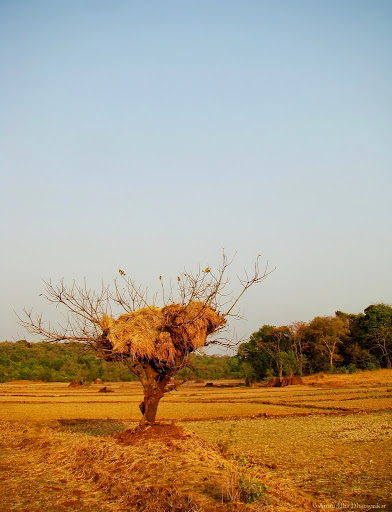
This place is inviolate , said the little girl who was our guide of her forest village Supegaon. It was noon in the middle of summer. We were forbid from eating any karvanda  once we crossed into the boundary created by tall trees along the edge of browning fields. The girl informed us that we have entered the God’s abode – locally called devrai – and everything was silent save for the leaves that crumbled under our feet. The ambiance of this place was cooler than the fields that surrounded it, and we were silent not out of choice but by an involuntary hush that settled upon us. I’ve still not come to explain the effect devrai ’s have on people. Perhaps it is psychological, perhaps just natural. But the fact rooted in the keepers of the devrai is that the silence is because of the Gods that dwell here: the protectors of the village, and the belief is shared almost uniformly throughout India. Ecologists today call it sacred groves, the most ancient community-based conservation ...