Posts

Showing posts with the label book

On the Book of Central India – Part II: The Doubt

Image
With my Northeastern buddy the Horay-bellied Himalayan Squirrel relishing Arunachali oranges. On July 7, 2013, a week after moving to Kanha, I journaled my observation on nature and human-nature interactions in Central India. My first ever memory is of an effervescent girl gently smacking a cow about to feed on someone’s backyard garden. With her brother in one arm, dressed in old school uniform, the barefooted girl led a line of cattle into the forest for grazing. This memory is as fresh as if it occurred only yesterday. She compelled me to look at myself, insecure and closed to the world – her world – shoed, full-sleeved, afraid of ants and mosquitoes, whatnot. That year, malaria, a millennia-old scourge of Central India, especially the hill regions, was particularly bad. Amidst this, from my cocoon, I romanticized the forest village life to my unadjusted unaccustomed infant eyes, and I imprinted on her, whom I ultimately followed, like cattle in a line, to see without rose-tinted gl...

On the Book of Central India – Part I: The Drive

Image
  Returning to the roots, the book sits along one of the many rivers it journeys with, Banjar On February 1, 2025, Our Roots Run Wild, a book of the history of the highlands of Central India, was published by The Alcove Publishers of New Delhi. Released at a small non-event at the New Delhi World Book Fair where I felt too embarrassed to talk or sign the book, it marked the day the book became available as paperback and e-book, primarily on Amazon India. This is a short three-part series on the writing journey of this book that I let consume me. In 2016, I started writing a longform essay hoping to publish it as a booklet of my experiences working in Madhya Pradesh, particularly in the region of Balaghat, Mandla, and Seoni districts. Working on the issues deemed important for wildlife conservation – particularly of large wild mammals – had put me in touch with the grassroots quite intimately. I worked not only for but also with the local communities, the Baiga folk, in particular...

What's Left of the Jungle by Nitin Sekar: a review

Image
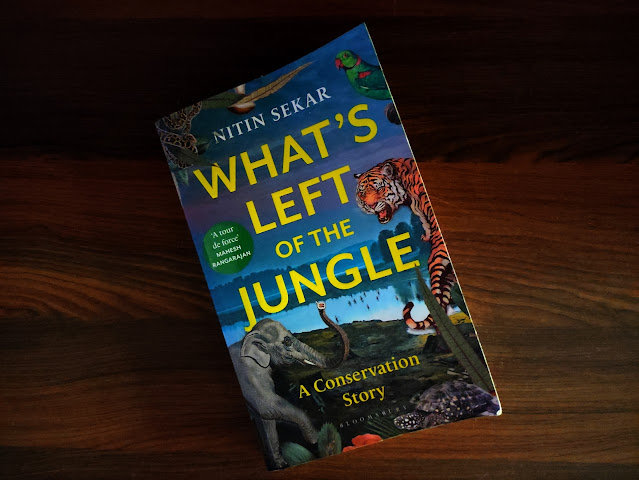
What's Left of the Jungle - A Conservation Story, by Nitin Sekar, published by BLOOMSBURY, 2022 Having visited the Himalayan foothill forests only as a tourist, and having only experienced its wildlife research and conservation aspects through research publications, What’s Left of the Jungle is a welcoming read on a protected area of West Bengal, where the author who studied seed-dispersal potential of wild Asiatic Elephants narrates his experiences and those of his resident associates of working and living in the region. This is a longish review of the book. This book adopts a pace that is perfect if one is to absorb the nuances of wildlife research and conservation in India. It's real lesson I feel, is in patience - whether through the US-based writer's journey as he circumnavigates the socioeconomic and ecological aspects of life in a wildlife refuge or the locally-born Akshu whose perspectives are engaging as the reader learns through his experiences right from his fo...

Field Guide to Insects and Spiders of Kanha Tiger Reserve

Image
After fourteen long months since I wrote a report on insects and spiders of Kanha in August , a few of us (myself, Malay and Ankita of Resurrect, and Kedar Gore of The Corbett Foundation) got together to discuss on turning this into something much more than just a report, and we came up with a field guide – a handy book on common insects and spiders of Kanha Tiger Reserve. Field Guide to Insects and Spiders of Kanha Tiger Reserve, now in stores. It is currently available in India on Amazon: http://www.amazon.in/Field-Guide-Insects-Spiders-Reserve/dp/8193208528/ref=sr_1_2?s=books&ie=UTF8&qid=1477455449&sr=1-2&keywords=kanha+tiger+reserve And also on BNHS:  http://bnhs.org/bnhs/index.php?option=com_virtuemart&view=productdetails&virtuemart_product_id=338&virtuemart_category_id=13&Itemid=538 For Europe (especially UK) it is available on NHBS:  http://www.nhbs.com/title/212834/a-field-guide-to-insects-spiders-of-kanha-tiger-reserve...

Some Insects and Spiders of Kanha Tiger Reserve

Image
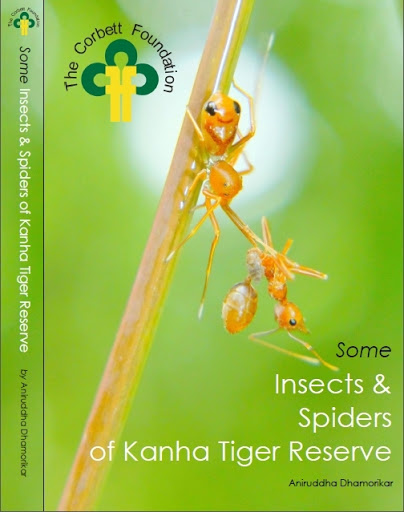
This report is published by The Corbett Foundation Cover: Amyciaea forticeps feeding on an Oecophyla smargdina with a Phorid fly sharing in the meal On behalf of The Corbett Foundation, I studied the insect and spider diversity of Kanha – and this study has revealed some important and interesting facets about Kanha’s ecology. This report is not a publication yet, and it will be some time since it will be made public – but those visiting Kanha Tiger Reserve (KTR) can visit the KTR head office in Mandla and shuffle through this report in their library, or pay a visit to our centre near Mukki Gate of Kanha where you can sit and browse through our library. This book covers 550 individual specimens of insects and spiders (436 insect species and 114 spider species) along with photographs and notes on their ecology. Mikia tepens (Walker), a Tachinid considered an "uncommon beauty" by Mik, whose name has been immortalized in this fly's genus, is a rare fly from Ka...

The Last Wave by Pankaj Sekhsaria: a review

Image
I have always wanted to visit the Andaman Islands, and I had written to Pankaj nearly half a decade ago about it, but I didn’t intend to visit the islands as a tourist, especially after the tsunami. The trip however never materialized and years later, today, Pankaj helped me visit the great islands through “The Last Wave”, and I learnt much more about the island than I would have if I were to visit as a mere tourist. Simply put, the book is relevant to those who have been to the islands as it is to those who wish to. Cover of The Last Wave: An Island Novel by Pankaj Sekhseria, Published by Harper Collins The Last Wave’s cover is outlaid on a mellow shade of green, with sights and signs distinctive of the Andamans: a Jarawa standing on what appears to be the Andaman Trunk Road, a fish and a dinghy signifying the basic livelihood of the island, a mugger basking near the base of the book, and between the title and the name of the author rests the flower of Papilionanthe teres . T...